SAILING WIND Available from J.W. Pepper
For
Solo Vibraphone
In Three Movements
|
|
|
The title Sailing Wind is
inspired by the desire to ride the wind (the vibrations of the
vibraphone) and to sail with it to visit the twenty-three
percussionists from across North America who commissioned the work. It
is written in 3 movements - From the East (meditative), From the West
(soulful, jazz and blues influence), and From North and South (joyful).
See this new work performed by
Jason Edwards at the University of Arkansas on March 21, 2010
(performance
link below). |
SEE THE MUSIC
SEE
THE PERFORMANCE
Purchase Score in PDF Format from HALIM EL-DABH MUSIC
SECRETS
OF
THE SKY AND EARTH
For
Marimba
|
|
|
Secrets of the Sky and Earth was
conceived as an exploration of the vibrational possibilities of the
marimba. Performance of this piece requires the player to be extremely
in-tune with the instrument and the space they are performing in and to
strive to create a connection with the listeners.
Secrets of the Sky and Earth was
written by Halim El-Dabh at the request of Blake Tyson. After Tyson was
accepted at the Eastman School of Music, he contacted El-Dabh and asked
him to write a piece for him to premier at Eastman.
This piece calls for multiple
roll types (esp. independent rolls) and requires the player to be very
smooth when changing techniques. An excellent performance piece that
will connect with the audience as well as show off technical
proficiency. |
SEE THE MUSIC
Purchase Score in PDF Format from HALIM EL-DABH MUSIC
ARIA
FOR
STRINGS
|
|
|
Aria
For Strings was written by Halim El-Dabh in 1949 when he was 28 years
old. He wrote the pieces during a deep reflective moment, experiencing
feelings about leaving his beloved Egypt for the creative industrial
United States.
The
work opens up with the first violins in A major expressing a soft tender
theme over an F sharp minor suspended chord treated like a
petal point. The work continues with subtle contrapunctual relations
featuring the violas while retaining the overall tapestry of nostalgia.
It ends with the celli over suspended strings supported by the basses.
El-Dabh attended informal
performances of his Aria For Strings at The Institute of Oriental Music
in Cairo in 1949. |
The piece was not performed
again until Nov. 17, 2007
at a program by the Rocky River Chamber Music Society at The West Shore
Unitarian Universalist Church in Rocky River, OH, performed by the
Hausman Quartet comprised of Isaac Allen - violin, Bram Goldstein -
violin, Laura Burns - viola, Yuan Zhang - cello with guest Bryan Thomas
on bass. This performance appears on the CD Chambers &
Concertos, 2009 by Halim El-Dabh Music LLC.
SEE THE MUSIC
Purchase the Score in PDF format from HALIM
EL-DABH MUSIC
STRING
QUARTET
|
|
|
The quartet opens with cello
playing low pizzicato allowing for a delicate sound decay. These
plucked notes are repeated to express a determination to stay
on the course. To this the first violin resonates with the Egyptian
folk tune in high artificial harmonics. This is expressed on a two
quarter tones maqam bespeaking the thirst for finding oneself. The
Egyptian folk tune translates into "I'm thirsty oh my countrymen -
please show me the way to quench my thirst." It is a thirst for
knowledge and for the unknown. It is also a search for self
realization. The second violin and the viola interact in a battle with
each other with harsh tremolos played near the bridge of their
instruments expressing restlessness of what might be in store
ahead. |
Again it is delicately
overshadowed by the main theme of hope on high harmonics.
In the
second movement musicians
are seated on the edge of their chairs asserting a strong will for all
open possibilities.
In
the third movement all the strings play sordini except the 'cello,
creating a sonorus dark tapestry with a touch of meloncholy. Over such
fabric the 'cello sings an undetermined melody of longing, a melody
which has no beginning and no end.
In
the fourth movement, excitement sets in with dancing intricate rythmic
nuances for joy. It expresses hope and the release of tension.
In
the fifth movement it is nighttime in the hot desert bringing mystery
into the environment with unexpected tiny sparks of light.
Finally
all the instruments join together into a fugue of long phrases
interwoven and coiling with one another with occasional clusters based
on Arabic maqam scales. This brings the quartet to its accomplished
journey.
SEE THE MUSIC
Price to be Arranged
- Score in PDF format from HALIM
EL-DABH MUSIC
TWO
MINUTES
TRIO FOR STRINGS
|
|
|
Two
Minutes Trio for Strings opens with strong rhythmic dissonances. The
dissonances are the driving force of the piece from beginning to end.
They are interrupted by quiet lyrical violin themes in counterpoint
with reflective responses from viola and cello. The piece ends with a
powerful unison of short dramatic statements tapering off with cello
pizzicato snapping against the wood of the instrument while the violin
is tapping the wood of the back of the bow against the open G string.
Two
Minutes Trio for Strings was written in 1956 by Halim El-Dabh while on
his way to a party at the home of Harold Rogers, the music critic for
The Christian Science Monitor.
|
El-Dabh
had been informed that there would be a three string players present.
So he set out to writing an impromptu piece for them to perform. The
piece was not performed again until Nov. 17, 2007 at a program by the
Rocky River Chamber Music Society at The West Shore Unitarian
Universalist Church in Rocky River, Ohio. It was performed by the
Hausman Quartet (Isaac Allen - violin, Bram Goldstein - violin, Laura
Burns - viola, Yuan Zhang - cello). This performance was released on
the CD Chambers & Concertos, 2009 by Halim El-Dabh Music LLC.
SEE THE MUSIC
Purchase the Score in PDF format from HALIM
EL-DABH MUSIC
THE
QUEST
|
|
|
The
Quest, composed in 2006, is scored for full symphonic orchestra. It is
written in three movements, The Globe, The Land Beyond and
Celebrations. The idea of the title The Quest is to bring all the
energies of the three movements together into one.
The
Globe opens with large suspended cymbals and three large tam tams
uniquely performed by rubbing superballs on the inner circular rough
side of the tam tam. This creates a special friction vibration that can
subtly fill up the concert hall.
The
second movement, The Land Beyond, starts with string basses
establishing an articulate compelling theme which gradually builds up
with the rest of the strings, creating interactions with short motifs
from woodwinds and brass. |
The movement ends with a reprise
from The Globe with tam tam vibrations.
The
third movement, Celebrations, opens with extended vibrations with the
special effect of all the strings playing behind the bridge. The
tension increases with wind like undulations which are played by
woodwinds and brass blowing air into the tubes of their instruments
with short vocal utterances inviting the people of the world to
celebrate.
Lively
repeated rythms are played as solo musicians leave the stage and greet
the visiting dignitaries. The work ends with continual resonances in
the concert hall reminding the audience of what was experienced.
SEE THE MUSIC
Price to be Arranged
- PDF format from HALIM
EL-DABH MUSIC
POMEGRANATE
CONCERTO
For
Alto Sax and Strings
|
|
|
The
Pomegranate Concerto is composed for alto sax and string orchestra. The
work focuses on the shape and structure of the delightfully tasty
pomegranate fruit. Ideas and themes are expressed in dialogues between
the sax and string group. The fruit has a copper-toned cover protecting
the jewel like seeds in small compartments; expressing a mystery of
relationship according to Egyptian riddle. The saxophone utilizes
lyrical themes with sparkling responses from strings and at times
dissonances and clusters of multiphonic tones.
The
work is in three continuous movements. Layers Over Layers in Oceans
Submarine, Pearls Within, and Tones of Copper. The Pomegranate Concerto
was commissioned by the Rocky River Chamber Music Society, Ohio. It
premiered on |
November 19, 2007 at The West
Shore Unitarian Universalist
Church in Rocky River, Ohio, performed by alto sax soloist Greg Banazak
with
The Hausman Quartet - violinists Isaac Allen and Bram Goldstein,
violist Lauren Burns, cellist Yuan Zhang plus Bryan Thomas on bass.
SEE THE MUSIC
Purchase the Score in PDF format from HALIM
EL-DABH MUSIC
THE
MIRACULOUS TALE
|
|
|
The
Miraculous Tale was written by Halim El-Dabh in 2006 for alto saxophone
and derabucca drum. It is written in three movements entitled
Lightening, Tenderness and Stratosphere.
Although
the derabucca is small, it possesses an almost infinitely wide range of
tones and timbres, ranging from very high, delicate and crystaline
tones to powerful, deep and resonant ones. The three main pitch levels
used in The Miraculous Tale are dum, ma and tak representing a
continuum
ranging from low to high. The small note heads represent an
embellishment to the main rhythm. The "slap" technique is executed by
slapping the outstretched hand, with fingers together, against the drum
head.
|
The
sound should be particularly
sharp and works best if the hand is slightly cupped (with thumb
underneath), with the fingertips contacting the drum head near the
center. This technique takes somewhat more practice and cultivation to
get it just right. When the technique of inserting the hand into the
bell to vary the pitch is called for, either hand may be used for this
purpose, according to the player's preference.
The
quarter tone featured in the
saxophone part of the second movement represents a pitch that is midway
between F sharp and A actually one quarter tone lower than the G sharp.
It is part of the Arabic maqam known as Bayati.
The
Miraculous Tale was
commissioned by the World-Wide Concurrent Premieres and Commissioning
Fund, Inc. El-Dabh attended the performance on his birthday on March 4,
2007 at Granoff Hall at Tuffs University with Ken Radnofsky on alto sax
and Takaaki Masuko on derabucca.
SEE THE MUSIC
Purchase the Score in PDF format from HALIM
EL-DABH MUSIC
IT
IS DARK
AND DAMP ON THE FRONT
|
|
|
It
Is Dark and Damp on the Front is a solo piano work expressing the
darkness and dampness that are germinated in the very psyche of
humanity whilst fighting at a war front, a murky front that exists in
reality inside every human being.
The
world premiere took place with the composer at the piano in Cairo,
Egypt at The Assembly Hall of All Saints Cathedral on Friday February
11, 1949. Halim El-Dabh performed his composition on a nine foot Pleyel
piano equipped with three pedals. He shook the audience into a standing
ovation. This single work changed his life from an agricultural
engineer to a music composer.
|
The composition fell into the
hands of Aaron Copland. Intrigued
by El-Dabh's ultra modern style, he invited him to become his
composition student at Tanglewood at The Berkshire Music Festival in
the USA. There he also studied with Irving Fine, Luigi Dallapiccola and
Leonard Bernstein.
A French critic, A. J. Patry
wrote in La Bourse
Egyptienne, commending the composer for his innovative use of sound and
pedal techniques stated that "El-Dabh touches the instrument in a
fashion of his own. He molds and fuses the sonorities of the piano
producing sounds and feelings pertaining to a basic culture. He has
exposed the European ear to a different way of playing. One must notice
the way he uses the pedals, producing from simple elements, complex
superpositions of harmonies." (Feb. 15, 1949).
El-Dabh describes his
technique of composing as "heteroharmony", a term he coined by
combining heterophony and chordal harmony in an interaction of chords
and clusters with a focus on the unison.
SEE THE MUSIC
Purchase the Score in PDF format from HALIM
EL-DABH MUSIC
EGYPTIAN
CALYPSO
|
|
|
When
composing Egyptian Calypso, Halim El-Dabh felt a connection between the
music of his childhood and that of Trinidad and Tobago. His imagination
took him from Egypt to the Andalusian culture of Morocco and Spain, and
the Arab troubadors of medieval times whose travels created a
cross-pollination of music throughout Europe. From there, his
imagination jumped the ocean to Trinidad and Tobago where the music
that had been cared for by the troubadours landed with the French colonists.
With the
arrival of the British, yet another layer of music was added to the
culture of the islands. Egyptian Calypso is about the
almost magical
possibility of music. The ability of music to travel
the world, to
combine with other styles, and to create sounds and ideas that, just
before the meeting, seemed beyond imagination.
|
 "Imagine a
reed boat, traveling across the Atlantic Ocean, carrying the secrets of
ancient Egypt to a Caribbean carnival. Composed for Steel Drum,
Egyptian Calypso's intricate harmonies dance with energy, reminding the
listener of an traditional Egyptian dance reframed within an island
rhythm."
Notes by
Deborah and Halim El-Dabh and Fred Pierre "Imagine a
reed boat, traveling across the Atlantic Ocean, carrying the secrets of
ancient Egypt to a Caribbean carnival. Composed for Steel Drum,
Egyptian Calypso's intricate harmonies dance with energy, reminding the
listener of an traditional Egyptian dance reframed within an island
rhythm."
Notes by
Deborah and Halim El-Dabh and Fred Pierre
SEE THE MUSIC
Purchase the Score in
PDF format from HALIM
EL-DABH MUSIC
SWEET
AND
PRICKLY PEAR
for
Violin and Derabucca
|
|
|
Sweet
and Prickly Pear was inspired by the composer Halim El-Dabh’s childhood
memories of this fruit:
“In
early morning hot summers in Heliopolis, Egypt, I would wake
up
with a strong desire for prickly pears. With anxiety I would wait for
the push cart vendor who would usually come to the house shouting and
singing, “teen shoky” - meaning “thorny figs” which comes in variable
colors of green, red and gold.
The
vendor would skillfully separate the thorns from the fruit before he
allowed me to devour it. The feeling of delight and satisfaction
settled in especially after realizing that the hair-like needles did
not touch my skin.
|
Writing
for the violin and derabucca allowed me to express that rush of
excitement that vibrates in musical terms as acute rythmic splashes
interwoven with variable snatches and motifs awakening deep intricate
resonances joining the violin and the derabucca in union.
The
“lazma” is that integral part of the composition which makes it
possible for the bow to dance on the violin string and for the fingers
to bounce on the derabucca.
Purchase the Score in
PDF format from HALIM
EL-DABH MUSIC
BELLY
DANCE
CLASSIC
Co-Composed by Charles J. Coven and Halim El-Dabh
For Percussion and Woodwind Quartet
|
|
|
Belly
Dance Classic was created by Halim El-Dabh and Charles J. Coven
employing traditional Arabic rhythms and drumming sonorities that are
open to improvisation.
The piece commences with a mysterious slow crescendo that increases in
dynamics into an energetic dance of life and harmony. The
interaction
between linear lines reflects the life that is found in conception in a
woman's belly.
Belly
Dance Classic is written for flute, oboe, clarinet, horn,
bassoon, maracas, tambourine or zills, 2 djembes, 3 or 4 derabucca, and
double bass. Other percussion instruments may be added for
improvisation. The woodwind parts can be substituted or combined with
other instruments in order to create the performers own interpretation
of the work.
|
El-Dabh
and Coven decided in 2004 that they wanted to co-compose a
dance piece for belly dance. Coven started writing the music and then
El-Dabh added to it, which was the beginning of a lively exchange. At
times, they would both sit together and work on the score side by side,
trying out their new creations. The music should be viewed as a loose
blue print; thus, performers are encouraged to improvise. "The most
beautiful things are found in the spur of the moment", Coven attests
to. El-Dabh says that "the music remains true to the Arabic
melismatic
passages."
El-Dabh
and Coven wrote Belly Dance Classic for Coven's senior class in
"Compositional Theory" at Kent State University. It was performed April
8, 2004 at the Kent State Auditorium under the baton of the late John
Ferrito.
Charles
J. Coven is a composer whose music seems to echo slow moving
herds of elephants on empty plains of cattle or battles between gods on
cracked soil. He came to music and composition later than most. At the
age of 17, after only one year of piano lessons, Coven played Edvard
Grieg's Concerto in A minor, Op. 16. But it was Chopin's music that
enticed Coven to commit his life to music and composition.
Coven
studied piano, composition and theory at Kent State University,
receiving a dual bacherlor's degree in composition and theory
from
Kent State University. Shortly after, he received a Masters
in
composition from California State University, Long Beach. He has
studied composition with Halim El-Dabh, John Ferrito, Carolyn Bremer,
and Michael Daugherty. Currently, he actively composes and manages his
own music studio in Kent, Ohio where he also teaches piano, guitar, and
composition, Recently, Coven has been composing theatrical music and
works that explores the juxtaposition of tonal and atonal sonorities,
He enjoys collaborating with other artists musicians, such as Gehrin
Deutch and Halim El-Dabh.
El-Dabh's
works are comprised of chamber, opera, symphony, ballet,
orchestra and electronic music which are inspired from the heart of the
cultures of Africa and Asia. His works have been performed world wide
at such notable venues as Lincoln Center, Kennedy Center For The
Performing Arts, Cairo Opera House, Metropolitan Opera House, Paris
Chatelet Theatre, Beijing Central Conservatory, Herodius Atticus, The
Bibliotheca Alexandrina and Broadway theaters. They are published by
Halim El-Dabh Music LLC, CF Peters, Oxford University Press, Smith
Publications/Sonic Art Editions, and Mark Batty Publisher.
El-Dabh
is presently University Professor Emeritus at Kent State
University where he continues to teach a class entitled "African
Cultural Expressions". His field research includes Congo, Egypt,
Ethiopia, Guinea, Mali, Morocco, Niger, Nigeria, Senegal, South Africa,
Sudan and Zaire. He has held previous teaching positions at Haile
Selassie University and Howard University. He is the recipient of two
Rockefeller Foundation fellowships, two Fullbright Awards, two
Guggenheim Fellowships, three residences at the McDowell Colony and
grants from Meet The Composer, Ohio Arts Council, The American
Philosophical Society, and Kent State University. He holds an honorary
doctorate from New England Conservatory and Kent State University.
El-Dabh's
works portray a unique synthesis of ancient civilizations and
contemporary composition techniques as well as new systems of notation.
His compositions are a fusion of sounds from the soul of ancient Egypt
with modern day musical ideas from around the world.
Notes by Halim El-Dabh, Deborah
El-Dabh and Charles J. Coven
Notes edited by Leatrice Bard Tolls
SEE THE MUSIC
|
Purchase the Score in
PDF format from HALIM
EL-DABH MUSIC
SYMPHONY
FOR ONE THOUSAND DRUMS
Outdoor
in a
football field or indoor in a
concert
hall with a minimum of 40 musicians
|
|
|
Instructions:
First Line - Deep Voices and Chanting, Deep Sounding Drums
such
as djembe, conga, frame drum and similar. Bass drum
for
indoor performance.
Second, Third and Fourth Lines - agogo African
double bells
may
be sustituted with various sized cow bells and various
mallet
percussion such as marimba and xylophone for both
outdoor
and indoor performances.
Fif th and Sixth Lines - heavy and medium bells similar to those
of
church bells may be substituted by tubular orchestra bells
for
both outdoor and indoor performances.
|
The
Seventh through Twelfth Lines - portray a planned formulated
chaos leading to a balanced order. These lines are identified by color
and graphic music notation which should be displayed on large banners.
They are to be freely interpreted by percussion instruments
different
from the first six lines.
Examples
are ceramic sounds, wooden
sounds, and low earthen deep vibration sound. The color red is
interpreted for warmth and fire, blue for calmness and serenity, gold
for excitement, brilliance and joy.
This
section is composed with graphic music notation. Volunteers should be
available to help with interpretation. The last six lines engage
nature's energy of balance, beauty, wisdom, love and fresh water
portrayed by the ancient dieties Maat the Goddess of balance, Isis the
Goddess of Motherhood and compassion, and Oshun the Goddess of fresh
water.
Each
line of the symphony score requires multiple
functions and participation in drumming, chanting, and dancing. Dumbek
drums are suggested for the dieties Maat and Isis as well
as the
section called Tobbul Mazzika.
The
main conductor will need ten
assistant conductors each with their own score. Mallet percussion will
also need a score. Volunteers will be needed to carry banners with the
color and graphic music notation. The performance can either be done
outdoors or indoors. For indoor concert performance a wind ensemble
could be added to interpret the color and graphic music notations
utilizing four tones - E, F# , A and G. Mallet percussion can also be
added for the deities section.
Program
notes by Halim and Deborah El-Dabh. Edited by Blake Tyson.
|
SEE THE MUSIC
SEE
THE PERFORMANCE
Purchase the Score in
PDF format from HALIM
EL-DABH MUSIC
IN
SEARCH
OF THREE GODDESSES
For
Solo
Timpani
|
|
|
In
2007, the Percussive Arts Society International Convention devoted an
entire day to works for solo timpani. I heard about the event at the
end of 2006 and immediately called my friend and teacher Halim El-Dabh.
I hoped that he would agree to compose a work that could be premiered
at the convention. He was very excited about the possibility, as the
idea of composing a timpani solo immediately reminded him of his
mother's wedding procession in 1890's Egypt.
When
Halim was a child, his mother told him the story of the
celebration. She was in a small,
tent-like structure on the back
of
a camel, surrounded by three attendants. The procession
included many musicians playing
instruments, and
featured |
naqurat
(the clay
ancestors of modern timpani). Two men riding on camelback played the
drums.
Halim
was inspired by the idea of the attendants as protectors, and
envisioned them as three goddesses. The first as Isis, the goddess of
compassion, love and motherhood, the second as Ma-a-yat, the goddess of
balance and truth, and the third as Oshun. Oshun is actually a Yoruba
goddess who represents fresh sweet water, the source of life.
- Blake Tyson
In
Search of Three Goddesses was premiered by Blake Tyson at the
Percussive Arts Society International Convention in Columbus, Ohio on
October 31, 2007.
|
SEE THE MUSIC
Purchase the Score in
PDF format from HALIM EL-DABH MUSIC
ANNOUNCING A NEWBORN
For
Voice
|
|
|
Announcing
A
Newborn, Habeeb El-Dabh
was written by Halim El-Dabh upon the birth of his first and only son,
Habeeb on March 24, 1979 when the composer was 57. The
original
was photocopied into invitations for a celebration of the birth held at
the composer's residence in Kent, Ohio which was well
attended.El-Dabh's works are comprised of chamber, opera, symphony,
ballet, orchestra and electronic music which are inspired from the
heart of the cultures of Africa and Asia. His works have been performed
world wide with such notable venues as Lincoln Center, Kennedy Center
For The Performing Arts, Cairo Opera House, Metropolitan Opera House,
Paris Chatelet Theatre, Beijing Central Conservatory, Herodius Atticus, the Bibliotheca
Alexandrina
and Broadway theaters. |
SEE THE MUSIC
Purchase the Score in PDF Format from HALIM
EL-DABH MUSIC
AAPEP AND RA
Narration
and String Bass
|
|
|
Aapep and Ra is a solo double
bass and
narration written by Halim El-Dabh for Bryan Thomas in 2004 describing
the struggle of two Egyptian Gods: Aapep, the God of Clouds and Ra, the
God of the Sun. Halim El-Dabh introduced Thomas to the African
musician-historian-social-commentator known as the Griot as he was
forming his own personal sense of importance as a musician. Aapep and
Ra is inspired by this Griot storytelling tradition. Though a timeless
story, current events mirrored Aapep and Ra when the piece was first
performed as The United States Office of the President was beating the
war drum loudly, using fear and manipulation of truth to get what it
wanted. Aapep and Ra describes a similar world out of balance and
suggests that feminine nature may be the path to resolution. |
The
work was originally performed with El-Dabh as the narrator, expanding
and improvising on the original text, at times chanting along with the
music. The original text has since found its way to some other plane of
existence and is recreated here from performance recordings. Many of
the spontaneous additions are included. The current edition also allows
for the bassist to also be the narrator.
Bryan
Thomas teaches double bass at Kent State University, where he received
his Bachelor in Music Performance. His major teachers have been Anthony
Knight, Scott Haigh and Mark Atherton of the Cleveland Orchestra and
solo bass virtuoso François Rabbath. Thomas maintains a busy life
performing in diverse musical situations and is grateful to El-Dabh for
showing him that being a musician can be an important service to the
world in its transformation.
Technical notes:
Aapep
and Ra occasionally calls for the double bass to be used as a drum.
>
Slap is notated as a high tone, played with the fingers of the left
hand on the left bass rib.
>
Heel is notated as a mid tone, played with the palm of the left hand on
the left bass rib.
>
Low palm is a bass tone, played with the left palm on the back of the
bass.
>
Strike strings with bow is notated with a box notehead. The hair at the
tip of the bow is used as
a
mallet on the top three strings.
In
the harmonic section starting measure 115, an occasional F and F# is
needed where there is no harmonic possible. Stop these notes but keep a
harmonic-like sound with the bow.
Notes
written by Bryan Thomas
Noted edited by
Deborah El-Dabh
Aapep
and Ra is published by Halim El-Dabh Music LLC
Purchase the Score in PDF Format
from HALIM
EL-DABH MUSIC
CANINE WISDOM
Halim El-Dabh Color Music Notation
|
|
|
So
goes the legend - Dog, man's best friend, risked his life to pull man
out of the abyss. But man alas responds to the dog with commands and an
authoritative attitude. The dog covers his ears - the dog done gone
deaf.
Created
with this in his mindseye, Halim El-Dabh weaves a synthesis of
resonances which evoke down to earth sounds mixed with the mystical and
magical realms. He writes for an extended range in all the
instruments, stemming from a desire to transcend limits and to push
beyond norms. He holds onto traditional elements and stays the
authentic while layering his tonal explorations in pursuit of new
dimensions of sounds. Truly avant-garde and eclectic. Written for
string bass, baritone sax, bass flute, piano, vocal, violin, oud and
percussion. |
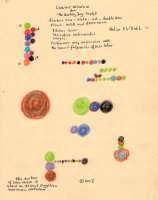
The painting can be played in
any
direction. The size of the circles represents volume and rhythm and
displays different harmonies with frequencies overlapping.
Purchase the Score from HALIM
EL-DABH MUSIC
OUT OF THE ABYSS
Halim El-Dabh Color Music Notation
|
|
|
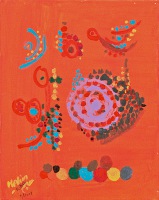
The
frequencies of color music reflect the inferno of the abyss that man
manages to escape through the same vibrant colors and frequencies that
ancient man used to guide him out of the abyss. Out of the Abyss is
part of a larger musical work along with Canine Wisdom entitled The Dog
Done Gone Deaf written by Halim El-Dabh for The Barking Dog
Sextet
performed in 2007 at the Suoni Per Il Populo in Montreal.
Written
for string bass, baritone sax, bass flute, piano, vocal, violin, oud
and percussion. The size of the circles represents volume and rhythm
and displays different harmonies with frequencies overlapping. |
Includes Two Page Western Score
Purchase the Score from HALIM
EL-DABH MUSIC
|
|
 |